



President Trump likes to complain about the “Russia Russia Russia Hoax,” but there is no question that he has an unusual affinity for Mother Russia. Wall Street whales, like former Apollo Group CEO Leon Black, understand it. Epstein did too. Post-Soviet Russia was a new frontier – lawless as the old Wild West, with capitalists and wannabe oligarchs racing to smash and grab resources and formerly state-run industries. Everything was for sale, including beautiful women; sexuality itself was commodified.
The activities of Trump and the Epstein class in that time and place are among the dirty secrets at the heart of the Epstein cover-up. This week, based on new discoveries in the files, we take a look at the Trump Tower Moscow, an unrealized dream, that links Trump with pieces we’ve run recently: Leon Black’s associations with Epstein’s Russian recruiters, Steve Bannon as the link between Epstein and the Mueller investigation, and Epstein’s red sparrows.
Evidence indicates that Leon Black agreed to finance Donald Trump’s early attempt to build a Trump Tower Moscow – something Black has since denied – at almost the same time Epstein started running the billionaire’s family foundation.
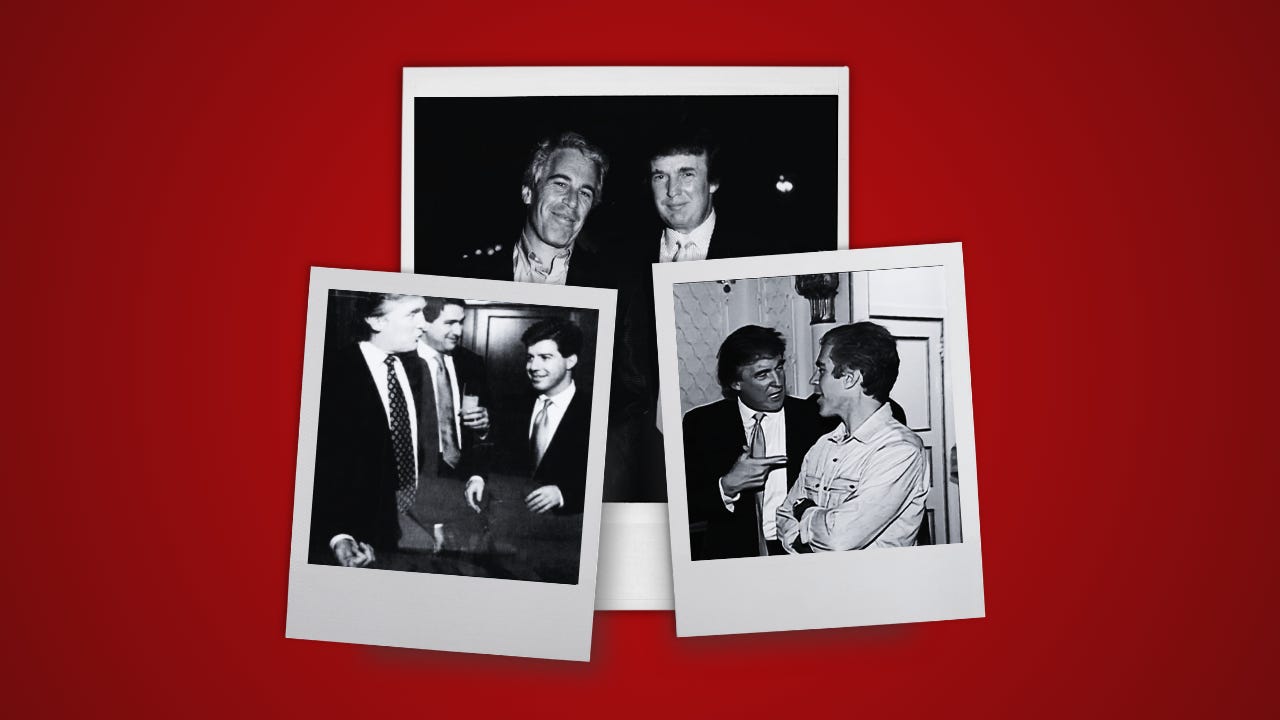
The 90s were the heyday of the Epstein-Trump brotherhood, with countless photos of the two of them gallivanting around New York with Ghislaine Maxwell, flying on each other’s planes, and stealing – or sharing – each other’s girlfriends. The period also coincides with the greatest business catastrophe of Trump’s checkered career: the nearly billion-dollar bankruptcy that was resolved only because craven and embarrassed bankers forgave much of the debt in order to save their institutional reputations.
Great for Donald! Except that the IRS apparently regarded that debt forgiveness as income. So Trump suddenly owed $500 million in taxes. Enter Epstein, the sometime tax expert, who, according to Michael Wolff, advised Trump to simply ignore the IRS. Epstein later told Wolff (according to him) that this episode was the chief reason Trump became so obsessive about shielding his tax history from public view.
Trump was clawing his way back into the good graces of the money men, when in November 1996, he and financier Leon Black went to Moscow together to scout opportunities for a Trump-branded luxury residential tower or hotel.
Black’s connection to the project was both familial and financial. In the early 90s, not long after the Wall fell, Brooke Group Ltd. – whose vice chairman, Richard Ressler, is Black’s-brother-in-law – announced a joint venture with Russian entities to manufacture and distribute cigarettes in the former Soviet Union. The company acquired prime Moscow real estate at the site of the old state-owned cigarette factory, about a mile from the Kremlin, and by 1993, held a 50-year lease on 40,000 square feet of downtown office space.
According to the Moscow Times, Trump’s 1996 visit was arranged and managed by Brooke chairman Bennett LeBow, who also accompanied him. “Donald is the preeminent marketeer and developer in the world,” LeBow said. “We want the best for Moscow – and Donald’s it.”
“We’re looking at building a super-luxury residential tower,” Trump told the Times, explaining that he’d chosen Moscow because it was “a city with a great future, great potential.”
It was not Trump’s first trip to Russia. He and Ivana – a Russian-speaking, collectivist-educated Czech – had been wined and dined there in 1987. That trip was apparently so ego-gratifying that Trump announced he would run for president when he returned to New York.
In his 1997 book, The Art of the Comeback, Trump praised Leon Black and mentioned meeting with Apollo about “potential financing.” LeBow himself confirmed to the Moscow Times, “We are confident that we have the financing in place to begin one of these projects,” he said, naming four financial backers: his own Brooke Group; the investment banking firm Jeffries & Company, Inc., the Apollo Group and the Trump Organization.
On November 3, 1996, two days before Trump and Black’s arrival, American developer Paul Tatum – a Republican fundraiser trying to build his own Western-style luxury hotel – was gunned down in the Moscow subway. His corpse, with 11 rounds from a Kalishnikov, was shown on Russian television.
Tatum had accused his business partner, Umar Dzhabrailov, a shady cat with reputed mob ties, of blackmailing him to squeeze him out of the project. Dzhabrailov had been appointed to that role by the same city officials who then met with Trump. (Decades later, Dzhaibrailov called Ghislaine Maxwell his “soulmate,” before taking his own life after the Epstein files release last year.)
It was a gory prelude to the Trump-Black visit.
International affairs analyst and longtime Russia expert Gilbert Doctorow, who kept a diary during his years living in Moscow, had unusually close proximity to the visit because he was friendly with Trump’s then-publicist Norma Foerderer. He recalled city officials dismissing Tatum as “a trouble-maker, a squatter.” “They surely knew how to handle Donald,” he wrote, “because the very word squatter gets him going.”
“It is clear that Trump will go ahead with the project whatever is going on here,” he continued. “And so he should, because he won’t be putting one cent of his own money into it: on the contrary he is selling his name for the marketing objective and that is all.” The real investors were going to be Bennett LeBow and moneybags like Leon Black.
Years later, the Senate Intelligence Committee, investigating the 2016 Trump campaign’s Russia connections, took a closer look at the trip. Steve Bannon, who was interviewed by the committee, later reported to Epstein (as evidenced in emails in the files) that he and Black were numbers three and four on the list of names investigators were asking about. The committee’s final report, released in summer 2020, included details of the 1996 trip.
So what exactly did Black and Trump get up to in Russia?
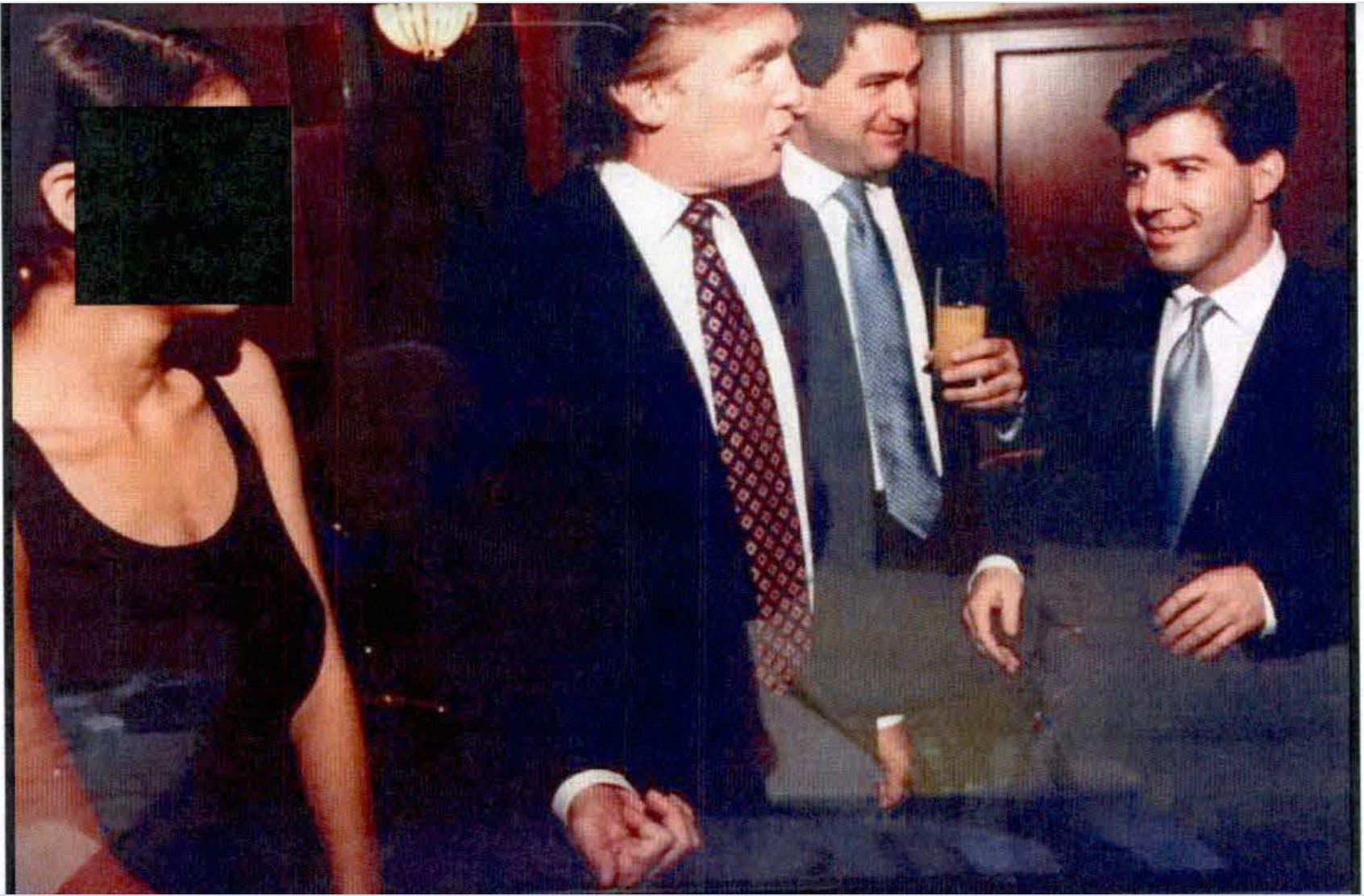
Leon Black himself told the committee that a night in Moscow with Trump involved going to a concert, then a “discotheque” and then maybe… Black was a little foggy on this… a strip club. David Geovanis, another American businessman working with Apollo in Moscow, painted a considerably more colorful picture:

Whatever happened after dark, the business relationship continued.
Just months after the Moscow trip, on January 31, 1997, New Valley – another Apollo-connected company – announced a joint venture with the City of Moscow and Donald Trump to renovate the Moskva Hotel, across from the Kremlin. The $175 million project would include 600 guest rooms, 200 private condominiums, a convention center, banquet halls, retail shops and extensive public space.
A year later, Black’s Apollo engaged with his brother-in-law’s Brooke Group and New Valley Corporation to form Western Realty Development LLC, a new entity designed to develop real estate in Moscow. Apollo was to contribute up to $58 million.
The Trump Tower Moscow was never developed, and Black has since denied he was ever involved. The paper trail suggests otherwise.
And Trump had now entered a world where, as the Village Voice put it, “the lines between government, gangsters, and business are inextricably linked.” It was also the natural habitat for a Coney Island thug turned international sex trafficker.
Nearly a year after the Trump-Black trip, right around when Epstein was named a director of the Black family foundation, he joined a September 1997 Council of Foreign Relations trip to Russia and Kazakhstan. In an archival document of the trip, a section titled “Delegation” lists his name and biography, alongside David Rockefeller, Blackstone co-founder Pete Peterson and Republican donor and New York Jets owner Woody Johnson.
Six months later, Epstein was back in Russia, this time with Microsoft’s then-CTO Nathan Myhrvold and others, apparently scouting investment opportunities in Russia’s “nuclear cities.” Epstein was photographed in Sarov, one of Russia’s top nuclear weapons centers, a city guarded by the Russian military with very limited access for foreigners.
That part of Epstein’s Russia play did not involve his friend Donald.
But another part of it synced up nicely.
A year before traveling to Moscow with Leon Black, Trump had bought the Miss Universe pageant. He got into the pageant business after discovering that he enjoyed playing Pygmalion to pliant young women like Marla Maples (who ultimately proved not pliant enough – more on that in my book on the Trump Women).
The Miss Universe pageant has been described as a feeder for commercial sex trafficking. It draws aspirants from all over the globe, who often spend large sums on plastic surgery, new teeth, wardrobes, and elocution classes in order to compete. Many turn to financing by rich and powerful patrons.
It goes without saying that this system offered rich opportunities for the likes of Jeff and his johns, including Black and Trump.
Years later, Trump’s 2013 Miss Universe pageant in Moscow provided the setting for salacious – and ultimately unsubstantiated – allegations about a Putin-recorded kompromat tape of Trump cavorting with prostitutes. But even as the reality show impresario rode the golden escalator toward the White House, a Trump Tower Moscow remained a gleam in his eye. The idea was revived in the 2010s by Trump enforcer Michael Cohen – who had himself pocketed nearly half a million dollars to connect the Russia-aligned leader of Ukraine with Trump – and by Felix Sater, a Moscow-born fraudster and longtime informant for the FBI.
That dynamic duo never got it off the ground either.
Substack Live this Thursday 7/16 at 2 PM ET
Join us this Thursday for a conversation with Media Matters for America senior fellow Matt Gertz. We’ll get into Steve Bannon’s years of living large with Epstein and his influence in the coming 2026 midterm election schemes.
Excellent reporting. So many potential suspects, so many likely criminals, so many guardians of pedophiles and no prosecutions in sight. Thank you for staying on this. We'll never be rid of the stench but we've got to try.
Paperwork trail indeed. One which possibly included Peter Thiel.
If you read Vitaly Churkin's Wiki it mentions he and Yuri Dubinin organized Trump's 1st visit to Moscow in 1987. One wonders how long it had been in the works.